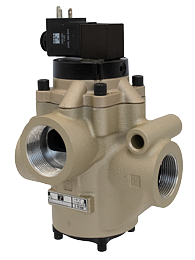




Vacuum, Low/High Temperatures, DIN & M12 Connection [21 Series] 2/2, 3/2, & 4/2 Functions, 1/4" to 1-1/2" Port Sizes
 Product Catalog - 21 Series Vacuum
- Perpendicular Poppet Face Seals Creates High-Flow and Positive Sealing
- Differential Piston Design Delivers Fast and Consistent Response Times
- Overwhelming Shifting Forces Provides No-Stick Operation
- High Velocity Air Flow Across Poppet Seats Allows Self-Cleaning and Strong Dirt Tolerance
- Superior Internal Guidance System and Self-Compensating Seals Delivers Long-Life
Valves for Vacuum Applications
Vacuum service valves are ideal for lifting, holding, vacuum packaging and moving anything from large objects to tiny particles.
They also provide an effective means for leak testing. The vacuum source typically comes from either a vacuum pump or a venturi.
In vacuum service applications, the pressure within the valve is reduced below atmospheric pressure. Consequently, atmospheric
pressure actually pushes air into the valve, instead of the common belief that air is “sucked” in by the vacuum.
Valves for Full Vacuum Applications
Full vacuum valves are ideal for applications where compressed air is unavailable. Full vacuum valves use the difference in
force between atmospheric pressure and the vacuum within the valve to actuate the valve. The full vacuum valve performs with
atmospheric pressure in port 1 and 10 to 30 inches of Mercury vacuum in the valve body.
Unable to load products. Please try again.
loading...
loading...
Product Overview
The ROSS Controls is the vacuum-rated, DIN and M12 connection variant of the 21 Series inline poppet directional control valve platform. Purpose-built for pneumatic and vacuum circuits operating across extreme temperature ranges from -40F (-40C) to 300F (150C), these valves combine the high-flow poppet construction of the 21 Series with a pressure range extending down to full vacuum, and feature quick-disconnect DIN EN 175301-803 and M12 electrical connections for rapid field installation and coil replacement.
The Series handles 2/2, 3/2, and 4/2 valve functions in port sizes from 1/4" to 1-1/2", with a maximum flow capacity of Cv 33 (32,000 Nl/min). The operating pressure range spans from vacuum to 150 psig (vacuum to 10 bar), enabling the same valve series to serve both vacuum service applications and standard compressed air circuits without requiring separate product families.
Vacuum service creates a distinct set of valve requirements compared to standard compressed air control. When pressure inside the valve drops below atmospheric, atmospheric pressure pushes air into the valve rather than the common misconception of air being pulled inward. The Series is specifically rated and tested for this service mode, making it reliable for lifting, holding, vacuum packaging, pneumatic conveying, and precision leak testing applications where consistent sealing under vacuum differential pressures is mandatory.
Fluorocarbon and Buna-N seal options extend the operational envelope across both high-temperature industrial process environments and low-temperature cold storage or arctic installations. TUV Rheinland SIL 2 certification (SIL 3 in redundant configuration) enables integration into safety-critical machine control systems. DIN and M12 quick-disconnect coil connections reduce electrical installation time and allow coil swaps without disturbing valve body or process piping.
Key Engineering Features
- Vacuum-Rated Pressure Range - Operates from full vacuum to 150 psig (vacuum to 10 bar), covering both vacuum service and standard compressed air applications in a single valve series. Validated for lifting, holding, vacuum packaging, conveying, and leak testing.
- Perpendicular Poppet Face Seals - Creates high-flow capacity with near-zero leakage and positive sealing under vacuum and pressure differentials, eliminating the bypass losses and vacuum-hold degradation common in spool valve designs.
- Differential Piston Design - Delivers fast and consistent response times throughout the life of the valve, with overwhelming shifting forces that ensure positive actuation from vacuum to full operating pressure without hesitation or sticking.
- No-Stick Operation - Overwhelming shifting forces ensure reliable actuation even after extended idle periods under vacuum hold conditions or in contaminated industrial environments, preventing costly production interruptions.
- High-Velocity Self-Cleaning Poppet Seats - Air and vacuum flow across poppet seats at high velocity, continuously removing particulate contamination during operation and reducing maintenance requirements in dirty vacuum conveying or packaging environments.
- Self-Compensating Seals for Extended Life - Superior internal guidance system automatically adjusts stroke length as seals wear, maintaining consistent sealing force and extending service life without requiring periodic maintenance adjustments.
- DIN EN 175301-803 and M12 Quick-Disconnect Connections - Simplifies electrical installation and enables rapid coil replacement without disturbing process piping or valve body, reducing planned and unplanned maintenance time significantly in production environments.
- Non-Locking Manual Override - Standard on all solenoid-controlled models for commissioning, troubleshooting, and system verification without external tools, particularly useful during vacuum system setup and leak testing.
- Extreme Temperature Seal Options - Fluorocarbon seals for media temperatures up to 300F (150C) and Buna-N seals for low-temperature operation down to -40F (-40C), covering food processing freezers, hot furnace environments, and arctic outdoor installations.
- TUV SIL 2 Certification (SIL 3 in Redundant Configuration) - Enables integration into safety-related control architectures per IEC 61508, IEC 61511, and ISO 13849, the highest safety integrity levels available for pneumatic and vacuum control components.
- Downloadable CAD Models - Available for all Series variants through the ROSS Controls website to streamline machine design integration and reduce engineering lead time.
Technical Specifications
General Specifications
| Parameter | Specification |
| Valve Functions | 2/2 (NC/NO), 3/2 (NC/NO), 4/2 |
| Construction | Poppet |
| Actuation | Solenoid Pilot Controlled; Pressure (Pneumatic) Controlled |
| Port Sizes | 1/4", 3/8", 1/2", 3/4", 1", 1-1/4", 1-1/2" |
| Thread Types | NPT and G (BSPP) |
| Operating Pressure | Vacuum to 150 psig (Vacuum to 10 bar) |
| Maximum Flow | Cv 33 / 32,000 Nl/min |
| Flow Media | Vacuum and filtered compressed air |
| Mounting | Inline; any orientation (vertical preferred) |
| Valve Body Material | Cast aluminum |
| Poppet Material | Aluminum and stainless steel |
| Seal Options | Fluorocarbon (high temp); Buna-N (low temp) |
| Manual Override | Non-locking button (solenoid models) |
| Electrical Enclosure | IP65 |
Temperature Ratings
The Series is specifically designed for operation outside standard temperature ranges. Seal material selection determines the applicable temperature envelope. These valves are rated for both vacuum and positive pressure operation across all temperature configurations.
| Configuration | Ambient Temperature | Media Temperature |
| Solenoid - High Temp (Fluorocarbon) | 0 to 180F (-17 to 82C) | 0 to 300F (-17 to 150C) |
| Solenoid - Low Temp (Buna-N) | 40 to 122F (-40 to 50C) | 40 to 175F (-40 to 80C) |
| Pressure Controlled - High Temp (Fluorocarbon) | 0 to 300F (-17 to 150C) | 0 to 300F (-17 to 150C) |
| Pressure Controlled - Low Temp (Buna-N) | 40 to 175F (-40 to 80C) | 40 to 175F (-40 to 80C) |
Important: For media temperatures below 40F (4C), compressed air must be free of water vapor to prevent ice formation inside the valve. In vacuum service, ensure the vacuum source is free of condensable vapors at low operating temperatures.
Electrical Data (Solenoid Pilot Valves)
All solenoids are rated for continuous duty with an IP65 enclosure rating.
| Voltage | Power Consumption |
| 12 VDC | 4.5 watts |
| 24 VDC | 4.5 watts |
| 24 VDC (M12 connection) | 4.8 watts |
| 120 VAC, 60 Hz | 6.5 VA |
| 240 VAC, 60 Hz | 6.8 VA |
Electrical Connection Options
| Connection Type | Coil Code |
| DIN EN 175301-803, Form A | 1 |
| DIN EN 175301-803, Form B | 2 |
| M12 Connector | 3 |
| 1/2" Conduit with 30" Leads | 4 |
| DIN Form B - Low Temp (Buna-N required) | 5 |
| 1/2" Conduit - High Temp (Fluorocarbon required) | 6 |
Flow Performance Data
Flow performance data for 2/2 Solenoid Pilot controlled valves (select sizes shown). The operating pressure range extends from vacuum to 150 psig for all configurations.
| Body Size | Port Size | Cv NC | Cv NO | Response M (ms) | Weight lb (kg) |
| 3/8 | 1/4" | 1.7 | 1.6 | 10 | 1.9 (0.9) |
| 3/4 | 3/4" | 7.7 | 7.4 | 14 | 4.3 (2.0) |
| 1-1/4 | 1-1/4" | 29 | 23 | 26 | 11.1 (5.0) |
| 1-1/4 | 1-1/2" | 31 | 23 | 26 | 11.1 (5.0) |
Response Time Formula: Response Time (ms) = M + (F x V), where M is the minimum response constant, F is the fill/exhaust factor, and V is the downstream volume in cubic inches. M and F values are published per port size and function in the ROSS 21 Series catalog.
Certifications & Compliance
| Certification/Standard | Detail |
| SIL Rating | SIL 2 (singular, HFT = 0); SIL 3 (redundant, HFT >= 1) per IEC 61508/61511, enabling the highest pneumatic and vacuum safety integrity levels. |
| Certifying Body | TUV Rheinland, one of the world's most respected third-party safety certification organizations. |
| Standards | IEC 61508, IEC 61511 for functional safety of safety-related systems. |
| Performance Level | EN ISO 13849-1: PL c (singular with application-specific diagnosis); PL e (redundant), meeting the most demanding machine safety requirements. |
| Declaration of Conformity | CE marking for both Solenoid Pilot Controlled and Pressure Controlled variants, satisfying EU Machinery Directive requirements. |
| Enclosure Protection | IP65, providing dust-tight protection and resistance to low-pressure water jets for harsh industrial vacuum and process environments. |
Typical Applications & Industries
Vacuum Material Handling and Pick-and-Place Automation
- Automated vacuum pad systems for lifting, positioning, and holding workpieces in assembly lines, including glass panels, automotive body panels, sheet metal, and large plastic components where mechanical grippers would damage surface finishes.
- High-speed pick-and-place operations in packaging, logistics, and electronics assembly where the combination of fast valve response and positive vacuum sealing enables precise, repeatable part handling at high cycle rates.
- Robotic end-of-arm tooling circuits requiring vacuum on-off control with fast response and positive vacuum hold between cycles, where DIN or M12 quick-disconnect connections simplify integration into robotic cable management systems.
- Vacuum conveying systems transporting powders, granules, and bulk materials including flour, sugar, plastic pellets, and pharmaceutical powders where consistent vacuum levels and reliable valve cycling are required.
Vacuum Packaging and Food Processing
- Vacuum packaging machines in food processing for meats, dairy, and perishable goods where the valve must reliably control chamber evacuation and atmospheric restoration across thousands of cycles per shift.
- Low-temperature vacuum packaging applications operating in chilled or frozen processing environments down to -40F, where Buna-N seals maintain flexibility and sealing integrity at temperatures that make standard valve seals brittle.
- Pharmaceutical and medical device packaging requiring consistent vacuum levels and leak-free valve sealing to ensure product sterility and packaging integrity.
- Consumer goods and electronics vacuum packaging where the series provides the vacuum control necessary for tamper-evident and moisture-barrier packaging applications.
Leak Testing and Quality Control
- Automated leak testing stations for automotive components, pressure vessels, and sealed assemblies where the valve's near-zero internal leakage and positive poppet sealing are critical for measurement accuracy.
- Vacuum decay and pressure decay leak test equipment where the valve must hold a stable vacuum or pressure reference without internal bypass, ensuring test results reflect only the part under test.
- Sequential test fixturing requiring reliable vacuum circuit switching across multiple test channels, using the 4/2 function to alternate vacuum and vent between test chambers.
High-Temperature Industrial Process Applications
- Steel and metals processing including hot rolling mills, annealing lines, and galvanizing lines where ambient and media temperatures routinely exceed 180F and Fluorocarbon seals are required for reliable valve operation.
- Thermoforming and plastics manufacturing for controlling vacuum hold on heated mold surfaces where media temperatures reach 300F and standard Buna-N seals would degrade and lose sealing integrity.
- Glass manufacturing for directional air and vacuum control near furnace and forming stations operating at extreme temperatures.
- Foundry and heat treat operations requiring pneumatic actuator control in close proximity to molten metal processes or high-temperature furnace environments.
Cold Storage, Refrigeration, and Arctic Environments
- Cold storage and refrigeration facilities operating vacuum and pneumatic actuators in freezer environments down to -40F, where Buna-N seals maintain flexibility and sealing integrity at temperatures that cause failures in standard valve seal compounds.
- Food and beverage blast freezing and cryogenic packaging lines where consistent vacuum control is needed in environments that also demand extreme cold tolerance from all pneumatic components.
- Outdoor installations in arctic or cold-climate pipeline control, processing facilities, and remote automation systems where ambient temperatures drop below -40F and standard valves freeze or bind.
Ordering and Model Number Configuration
The ROSS 21 Series uses a structured model number system. Below is a breakdown for a 2/2 solenoid pilot controlled valve. The Series models include vacuum-rated configurations indicated by the body/port size code.
|
Model Number Structure: 21 - 7 - 1 - B - 200 - 1 - W - 1
21 Series (21 Series)
7 Actuation (7 = Solenoid Pilot, 5 = Pressure/Pneumatic)
1 Function (1 = 2/2 NC, 2 = 2/2 NO, 3 = 3/2 NC, 4 = 3/2 NO, 6 = 4/2)
B Revision Level
200 Body/Port Size Code (vacuum-rated configurations use designated size codes)
1 Seal Material (1 = Fluorocarbon, 2 = Buna-N)
W Voltage Code (H = 12 VDC, W = 24 VDC, Z = 120 VAC/60 Hz, Y = 240 VAC/60 Hz)
Dash Separator
1 Coil Type / Temperature Code |
Voltage codes: H = 12 VDC, W = 24 VDC, Z = 120 VAC/60 Hz, Y = 240 VAC/60 Hz.
Coil type codes for solenoid models: 1 = DIN Form A (standard), 2 = DIN Form B (standard), 3 = M12, 4 = 1/2" Conduit (standard), 5 = DIN Form B (low temp, Buna-N required), 6 = 1/2" Conduit (high temp, Fluorocarbon required).
For G (BSPP) threads, add "D" after the series prefix (e.g., D2171B2001W-1). Low-temperature solenoid options are available in 3/8 and 3/4 body sizes only.
The Series models are vacuum-rated variants. Consult the ROSS 21 Series Vacuum catalog for the complete model number table covering all vacuum-rated body/port size codes.
Accessories
Electrical Connectors
ROSS offers a full range of prewired and standalone DIN EN 175301-803 connectors in Form A and Form B configurations, with options for cable grip or 1/2" NPT conduit entry. Lighted connector versions are available for 24 VDC, 120 VAC, and 230 VAC to provide visual solenoid-energized indication. M12 cable assemblies are also available for systems using M12 quick-disconnect wiring infrastructure.
Exhaust Silencers
Aluminum exhaust silencers are available for port sizes 1/2", 1", and 1-1/2", rated to 290 psig (20 bar). Note: in vacuum service applications, exhaust silencers are typically not installed on the vacuum side of the circuit. Silencers are applicable to the compressed air supply and exhaust ports in mixed vacuum/pressure circuits.
| Port Size | Thread | Cv (Nl/min) | Model (NPT) | Model (G) |
| 1/2" | Male | 6.8 (6,700) | 5500A4003 | D5500A4003 |
| 1" | Male | 18 (18,000) | 5500A6003 | D5500A6003 |
| 1-1/2" | Female | 39 (38,000) | 5500A8001 | D5500A8001 |
Warning: Exhaust silencers must have flow capacities at least as great as the exhaust capacities of the valves. Contaminated silencers can cause increased back pressure and affect valve operation.
Related Products & Accessories
- 21 Series Low/High Temperature DIN & M12 Valves (Non-Vacuum) - Standard pressure (non-vacuum) rated variant of the 21 Series with DIN and M12 connections for extreme temperature applications, operating from 30 to 150 psig. https://www.rosscontrols.com/en/series/2759-lowhigh-temperatures-din-m12-connection-21-series
- 21 Series Classic Low/High Temperature Valves - Standard 1/2" conduit connection variants of the 21 Series for extreme temperature applications. https://www.rosscontrols.com/en/series/231-low-high-temperatures-classic-21-series
- 27 Series Standard Temperature Valves - Standard temperature inline poppet valves with port sizes up to 2-1/2" for higher flow requirements. https://www.rosscontrols.com/en/series/230-standard-temperatures-classic-27-series
- Electrical Connectors - DIN and M12 connectors, prewired assemblies, and lighted indicators for ROSS solenoid valves. https://www.rosscontrols.com/en/series/91-electrical-connectors
- Exhaust Silencers - Aluminum silencers rated to 290 psig for port sizes 1/2" through 1-1/2" to reduce exhaust noise. https://www.rosscontrols.com/en/series/90-silencers
- Lockout Valves (Energy Isolation) - L-O-X lockout valves for safe energy isolation during maintenance per OSHA lockout/tagout requirements. https://www.rosscontrols.com/en/series/1287-lockout-valves-15-series
Frequently Asked Questions (FAQ)
Q: What differentiates the series from the 2759 Series?
A: The primary difference is the operating pressure range. The Series is vacuum-rated, with a pressure range extending from full vacuum to 150 psig (vacuum to 10 bar). The 2759 Series operates from 30 to 150 psig and is not rated for vacuum service. Both series share the same DIN and M12 quick-disconnect connections and the same extreme temperature seal options. Select the series any time the application requires below-atmospheric pressure operation.
Q: What vacuum applications are these valves suited for?
A: The Series is suitable for vacuum lifting and holding using vacuum pads, vacuum packaging, pneumatic conveying under vacuum, and precision leak testing. The vacuum source is typically a vacuum pump or venturi ejector. In vacuum service, atmospheric pressure pushes air into the valve from the downstream side, rather than the conventional positive-pressure direction, and the series poppet construction is specifically rated for reliable sealing and actuation under this condition.
Q: What is the maximum operating temperature?
A: The highest-rated configuration, a pressure-controlled valve with Fluorocarbon seals, supports ambient and media temperatures up to 300F (150C). For solenoid pilot models with Fluorocarbon seals, maximum media temperature is 300F with an ambient limit of 180F for the solenoid enclosure.
Q: What is the minimum operating temperature?
A: With Buna-N seals, the low-temperature models operate down to -40F (-40C) for both ambient and media conditions, making them suitable for arctic environments and cold-storage or blast-freezing applications.
Q: Can these valves be used in safety-critical (SIL-rated) applications?
A: Yes. The 21 Series platform is TUV Rheinland certified to SIL 2 (IEC 61508/61511) and PL c (EN ISO 13849-1) in singular application. In a redundant (1oo2) configuration, the valves achieve SIL 3 and PL e, applicable to vacuum and pressure control circuits within safety-related machine control systems.
Q: Which seal material should I select?
A: Choose Fluorocarbon for high-temperature applications where media temperatures reach up to 300F. Choose Buna-N for low-temperature applications where media or ambient temperatures drop to -40F. The low-temperature DIN Form B coil (code 5) requires Buna-N seals, while the high-temperature conduit coil (code 6) requires Fluorocarbon seals. Both seal options are rated for vacuum service.
Q: Are NPT and BSPP (G) thread options both available?
A: Yes. Standard models ship with NPT threads. To order with G (BSPP) threads, add "D" as a prefix to the model number (e.g., D2151B2V51).
Q: What pilot supply pressure is required for vacuum service?
A: For internal pilot supply, the inlet pressure must meet the minimum operating threshold. For vacuum service applications, an external pilot supply is typically required since the inlet port operates below atmospheric pressure. External pilot pressure must be equal to or greater than the inlet pressure requirement. Consult the ROSS 21 Series catalog for specific pilot supply requirements by body size and function.
Q: Do these valves require lubrication?
A: The valve itself does not require air line lubrication. In vacuum service, lubricant introduction into the vacuum circuit is typically not appropriate. When optional accessories such as air index devices are installed on non-vacuum ports, lubrication may be necessary. When used, lubricant should be petroleum-based, ISO 32 viscosity or lighter.
Q: What is the IP rating of the solenoid enclosure?
A: All solenoid pilot valves carry an IP65 enclosure rating, providing dust-tight protection and resistance to low-pressure water jets for harsh industrial environments including vacuum packaging lines and food processing areas subject to washdown.
Q: Can the valve be field-converted between internal and external pilot supply?
A: Yes. ROSS 21 Series valves can be field-converted from internal to external pilot supply by relocating the pipe plug between the external pilot port and the internal pilot passage. For vacuum service applications, external pilot supply is the standard configuration. Contact ROSS for the updated model number to maintain proper documentation.
Q: Are 3D CAD models available for design integration?
A: Yes. Downloadable CAD models are available for all Series variants through the ROSS Controls website at rosscontrols.com.
Q: What is the expected lead time?
A: Standard manufacturing lead times for quantities of 10 or fewer units are typically 3 to 4 weeks, with shipping available throughout the United States.
Q: How do I calculate valve response time?
A: Use the formula: Response Time (ms) = M + (F x V), where M is the minimum response constant, F is the fill/exhaust factor, and V is the downstream volume in cubic inches. M and F values are published per port size and function in the ROSS 21 Series catalog. For vacuum circuits, use the published exhaust constants since vacuum application draws down volume rather than filling it.
Installation & Maintenance Guidelines
- Mount inline in any orientation; vertical mounting is preferred for optimal performance and condensate drainage.
- For vacuum service applications, external pilot supply is typically required because inlet port pressure is below atmospheric. Ensure external pilot air supply is clean, dry, and at sufficient pressure to meet the valve's minimum operating requirement.
- Supply filtered compressed air (5-micron filtration recommended) on any compressed air side of the circuit to maximize valve life.
- Do not restrict supply lines or exhaust ports on the compressed air side, as this can reduce pressure below the minimum operating threshold and cause erratic operation.
- Air and gas flowing through the valve in vacuum service must be free of water vapor at media temperatures below 40F (4C) to prevent ice formation inside the valve passages.
- Confirm that vacuum source capacity (pump or venturi) is adequate to maintain required vacuum levels after accounting for circuit volume and any allowable vacuum decay rate.
- Use only petroleum-based lubricants with an aniline point between 180F and 220F, ISO 32 viscosity or lighter, on non-vacuum circuit ports where lubrication is required. Avoid phosphate-type additives.
- Verify that exhaust silencers on compressed air ports have flow capacities at least as great as the exhaust capacities of the valves. Contaminated silencers can cause increased back pressure.
- When installing in high-temperature environments above 180F ambient for solenoid models, verify the solenoid coil is rated for the application temperature and that Fluorocarbon seals are specified.
- For low-temperature installations below 0F, confirm that Buna-N seals are specified and that the vacuum or compressed air supply is dried to a dew point below the minimum operating temperature.
- Perform all service and maintenance only after shutting down the system, exhausting all pressure and vacuum, and implementing lockout/tagout procedures per OSHA 1910.147 and EN 1037.
Warranty & Global Support
ROSS Controls provides a one-year warranty on all products, covering defects in material and workmanship from date of purchase.
Global technical support is available through ROSS offices in the USA (headquarters in Ferndale, Michigan), Canada, Brazil, Germany, France, United Kingdom, India, China, and Japan.
Contact ROSS Controls USA at +1-248-764-1800 or visit rosscontrols.com for product configuration, technical support, and distributor locator services.
For complete technical data, dimensional drawings, and valve configurator access, visit the ROSS Controls product page or contact ROSS Controls at (800) 438-7677.
Download Catalog: https://www.rosscontrols.com/en/documents/5342/vacuum-21-series-din-m12
Download Documents
Vacuum, Low/High Temperatures, DIN & M12 Connection [21 Series]