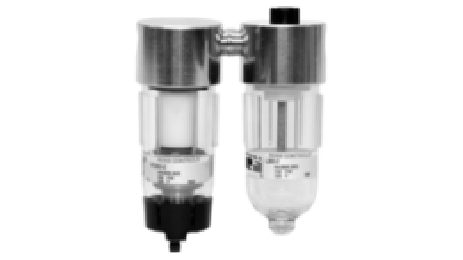




Filter and Lubricator Miniature Series Port Sizes 1/8" & 1/4"; Flow to 19 scfm (538 l/min)
 Product Catalog
Installation Instructions
Product Catalog
Installation Instructions
- Inline mounting
- Wick-feed lubricator or quick fill cap
- High-strength polycarbonate plastic bowls, or aluminum bowls
- Automatic drain, or manual drain filter
Unable to load products. Please try again.
loading...
loading...
Product Overview
The ROSS Controls Miniature Series Filter and Lubricator is a compact, inline-mounted air preparation unit engineered for pneumatic systems requiring simultaneous particulate filtration and oil-mist lubrication in space-constrained installations. Designed for port sizes of 1/8 and 1/4 inch, the series delivers flow capacity up to 19 scfm (538 l/min) while maintaining a lightweight, minimal-footprint form factor suitable for small pneumatic circuits and decentralized machine segments.
The filter element is a 5-micron rated polyethylene element that removes particulate contamination and coalesces water aerosols from the compressed air supply, protecting downstream actuators, cylinders, and tooling from abrasive wear and corrosion. Accumulated condensate is removed through a choice of automatic or manual drain, giving system designers flexibility to match drain selection to the duty cycle and service access conditions of the installation.
Lubrication is delivered through a wick-feed mechanism, which provides consistent oil-mist generation across a wide range of flow rates. The wick design functions reliably in both high-flow and low-flow operating conditions, with dedicated low-flow models available for applications where air consumption falls below 1 scfm (0.47 l/s). Oil adjustment is internal and tamper-resistant, preventing unauthorized changes to lubrication rates in production environments.
Bowl options include high-strength polycarbonate plastic for standard environments and aluminum metal bowls for applications requiring higher pressure capability or elevated operating temperatures up to 150 degrees F (66 degrees C). Both bowl variants use the same head assembly and replacement cartridge components, simplifying service and spare parts management across mixed installations.
Key Engineering Features
- Inline Mounting - Compact inline installation fits directly into the air supply line without requiring a separate mounting bracket or panel cutout, minimizing system footprint in tight machine enclosures.
- Wick-Feed Lubricator Design - Wick-feed mechanism provides stable and consistent oil-mist delivery across the full flow range, including dedicated low-flow models for systems with air consumption below 1 scfm (0.47 l/s).
- Internal Tamper-Resistant Oil Adjustment - Oil delivery rate is adjusted internally and locked against unauthorized changes, maintaining specified lubrication levels in production environments subject to operator interference.
- Quick-Fill Cap Option - Optional quick-fill cap allows oil reservoir replenishment without removing the bowl or interrupting compressed air supply, reducing downtime during scheduled maintenance.
- 5-Micron Filter Element - Standard 5-micron polyethylene filter element removes particulate contamination and coalesces liquid water, protecting downstream pneumatic components from wear and corrosion.
- Choice of Bowl Materials - High-strength polycarbonate bowl for standard conditions or aluminum metal bowl for higher operating pressures up to 200 psig (14 bar) and temperatures up to 150 degrees F (66 degrees C).
- Automatic or Manual Drain Options - Automatic drain expels accumulated condensate without operator intervention; manual drain provides condensate control in systems where automatic discharge is not permitted.
- All-in-One Filter and Lubrication Module - Combines particulate filtration and oil-mist lubrication into a single assembly, eliminating the need for separate components and reducing overall installation cost and complexity.
- Replaceable Cartridge Construction - All working parts, including the wick mechanism and filter element, are housed in an easily replaceable cartridge, reducing repair labor and enabling fast field servicing.
- Sintered Bronze Filter Element Options - Optional 5-, 20-, and 40-micron sintered bronze filter elements are available for applications requiring higher filtration efficiency or chemical compatibility beyond standard polyethylene.
Technical Specifications
General Specifications
| Parameter | Specification |
| Series | Miniature |
| Function | Filter and Lubricator (combined unit) |
| Lubricator Type | Wick-Feed |
| Mounting Style | Inline |
| Port Sizes | 1/8" and 1/4" NPTF or G (BSPP) |
| Maximum Flow Rate | 19 scfm (538 l/min) |
| Filtration Rating | 5 micron (standard polyethylene element) |
| Bowl Capacity | 2 oz (60 ml) |
| Bowl Options | High-strength polycarbonate or aluminum metal |
| Drain Options | Automatic drain or manual drain |
| Fill Method | Fill port (standard) or quick-fill cap (optional) |
| Flow Type | High-flow and low-flow models available |
| Minimum Flow (High-Flow) | 1/8" port: 2 scfm (0.94 l/s); 1/4" port: 6 scfm (2.8 l/s) |
| Minimum Flow (Low-Flow) | Less than 1 scfm (0.47 l/s) |
| Oil Adjustment | Internal, tamper-resistant |
| Fluid Media | Compressed air |
| Filter Element Material | Polyethylene (standard); sintered bronze (optional: 5, 20, 40 micron) |
| Head Material | Aluminum |
| Seal Material | Nitrile |
| Replacement Filter Element (Standard) | 933K77 |
Temperature Ratings
Temperature limits depend on bowl material selection. Polycarbonate bowls are limited to lower temperatures; aluminum metal bowls extend the operating range.
| Configuration | Ambient Temperature | Media Temperature |
| Polycarbonate Bowl (Automatic Drain) | 40 to 125 F (4 to 52 C) | 40 to 125 F (4 to 52 C) |
| Polycarbonate Bowl (Manual Drain) | 40 to 125 F (4 to 52 C) | 40 to 125 F (4 to 52 C) |
| Metal (Aluminum) Bowl (Automatic Drain) | 40 to 150 F (4 to 66 C) | 40 to 150 F (4 to 66 C) |
| Metal (Aluminum) Bowl (Manual Drain) | 40 to 150 F (4 to 66 C) | 40 to 150 F (4 to 66 C) |
Important: Do not exceed the bowl-specific temperature limits. Polycarbonate bowls must not be exposed to solvents, halogenated hydrocarbons, or incompatible chemicals; use metal bowls in such environments.
Certifications & Compliance
| Certification/Standard | Detail |
| Fluid Media | Rated for filtered compressed air service only. |
| Construction Standards | Manufactured to ROSS Controls engineering standards for air preparation components used in industrial pneumatic systems. |
| Thread Standards | NPTF threads per ANSI/ASME B1.20.3; G (BSPP) threads per ISO 228-1 available on all models. |
Typical Applications & Industries
Machine Tool and CNC Machining Centers
- Spindle air bearing lubrication on CNC turning centers and machining centers where consistent micro-mist delivery at flows below 6 scfm prevents bearing wear without over-lubrication of precision spindle components.
- Tool changer actuator protection on small machining centers, delivering filtered air with controlled lubrication to pneumatic cylinders driving automatic tool change mechanisms.
- Air-driven collet and chuck actuation on lathes and grinders, where the compact 1/4-inch port size fits within tight machine enclosures without reducing airflow capacity.
- Coolant system air purge circuits requiring clean, lightly lubricated air to prevent contamination migration into spindle air paths.
Semiconductor and Electronics Manufacturing
- Wafer handling robot joint lubrication on compact pneumatic pick-and-place arms, where the miniature form factor allows installation close to the end effector to minimize oil carry-over distance.
- Precision assembly station pneumatic actuator protection in cleanroom-adjacent areas where space for separate filter and lubricator units is not available.
- PCB depaneling machine actuator circuits, providing filtered and lubricated air to high-cycle pneumatic cylinders in a compact inline package.
- Test fixture pneumatic valve supply conditioning in bench-top and rack-mounted automated test equipment where port size and unit depth are constrained by enclosure geometry.
Food and Beverage Processing
- Bottling line cap-tightening head actuators and small pneumatic cylinders on filling and capping machines, where the manual drain prevents automatic discharge of condensate in areas with strict housekeeping requirements.
- Labeling machine cylinder supply conditioning where precise, low-volume lubrication is required to maintain consistent labeling head stroke speed without contaminating product contact surfaces downstream.
- Portion control and dispensing valve pilot supply preparation, ensuring clean and lubricated air reaches solenoid pilot valves on packaging and dispensing equipment.
- Conveyance system diverter actuators on small-diameter product lanes, where the compact 1/8-inch port size matches the reduced cylinder bore requirements.
Automotive and Assembly Automation
- Robotic end-of-arm tooling pneumatic supply on small assembly robots, delivering filtered and lubricated air directly at the wrist joint to protect lightweight cylinders from contamination.
- Leak test fixture actuator supply preparation on engine and transmission component testers, conditioning compressed air for pneumatic clamp and seal actuators.
- Small bore cylinder supply in vehicle interior trim assembly, where wick-feed lubrication ensures consistent stroke performance across high-cycle trim insertion and clip-setting operations.
- Door panel and glass assembly jig pneumatic supply, protecting suction cup actuators and alignment cylinder seals through consistent filtration and lubrication at the point of use.
Pneumatic Hand Tools and Maintenance Applications
- Inline air line lubrication for pneumatic screwdrivers, nut runners, and grinders used in light assembly operations, installed at the tool connection point for maximum effect.
- Maintenance department portable air supply conditioning stations, providing filtered and lubricated supply to pneumatic tools from fixed drops in manufacturing facilities.
- Blow-off gun supply conditioning where particulate filtration prevents contamination of sensitive surfaces during air blow-off cleaning operations.
- Small actuator supply on custom machine builds and retrofits, where a compact combined filter-lubricator simplifies the air preparation circuit to a single component.
Ordering and Model Number Configuration
The Miniature Series Filter and Lubricator is ordered by specifying the model number that encodes port size, thread type, bowl material, and drain type. For G (BSPP) thread, prefix the model number with 'C'. Contact ROSS Controls for configuration assistance.
|
Model Number Structure: 5 3 1 1 C 2 0 1 2
5 Product Family (5 = FRL Air Preparation)
3 Series Code (3 = Filter/Lubricator Combination)
1 Bowl Material (1 = Polycarbonate, 2 = Metal/Aluminum)
1 Size Code
C Body Revision Level
2 Port Size (1 = 1/8", 2 = 1/4")
0 Mounting Type
1 Drain Type (1 = Manual, 2 = Automatic)
2 Fill Method (1 = Fill Port Manual, 2 = Fill Port Auto)
Prefix 'C' before model number = G (BSPP) thread version Example: C5311C2012 = 1/4" G thread, Polycarbonate bowl, Automatic drain |
Standard thread is NPTF. For G (BSPP) threads, prefix the model number with 'C' (example: C5311C2012).
Bowl material selection determines operating pressure and temperature limits. Polycarbonate bowls are rated to 150 psig (10 bar) and 125 F (52 C); metal (aluminum) bowls are rated to 200 psig (14 bar) and 150 F (66 C).
Automatic drain models require minimum inlet pressure of 15 psig (1 bar) to activate the float drain mechanism. Manual drain models can be used from 0 psig.
Low-flow lubricator models are available for applications with air consumption below 1 scfm (0.47 l/s). Contact ROSS Controls to specify low-flow requirements.
Optional quick-fill cap replaces the standard fill port to enable reservoir refilling without disconnecting the unit from the air supply.
Optional replacement filter elements: 5-micron sintered bronze (R-KA130-27E5), 20-micron sintered bronze (R-KA130-27E4), 40-micron sintered bronze (R-KA130-27E3).
Accessories
Replacement Filter Elements
Standard and optional replacement filter elements for the Miniature Series. The standard 5-micron polyethylene element (933K77) is the most commonly stocked item. Sintered bronze elements provide alternative filtration ratings and improved chemical compatibility.
| Element Rating | Material | Model Number |
| 5 micron (Standard) | Polyethylene | 933K77 |
| 5 micron (Optional) | Sintered Bronze | R-KA130-27E5 |
| 20 micron (Optional) | Sintered Bronze | R-KA130-27E4 |
| 40 micron (Optional) | Sintered Bronze | R-KA130-27E3 |
Mounting Brackets and Clamps
Panel mounting brackets allow the inline Series units to be secured to surfaces using a 1-3/16 inch (30 mm) panel hole for drop-in mounting. Contact ROSS Controls for bracket model numbers and installation hardware.
Modular Connection Accessories
Module connecting clamps (R-A118-105) and brackets with screws (R-A118-103) are available when combining the series filter-lubricator with other ROSS FRL components in a modular assembly.
| Description | Model Number |
| Bracket and Screw | R-A118-103 |
| Module Connecting Clamp | R-A118-105 |
Related Products & Accessories
- 136 Mid-Size Filter and Lubricator Series - Modular filter and lubricator for port sizes 1/4 to 1/2 inch, delivering up to 100 scfm (2,832 l/min) with sight-feed lubrication and zinc or polycarbonate bowls. https://www.rosscontrols.com/en/series/136-mid-size-series
- 137 Full-Size Filter and Lubricator Series - Modular filter and lubricator for port sizes 1/4 to 3/4 inch, delivering up to 138 scfm (3,906 l/min) with wick-feed or sight-feed lubrication options. https://www.rosscontrols.com/en/series/137-full-size-series
- 138 High-Capacity Filter and Lubricator Series - Inline filter and lubricator for port sizes 3/4 to 1 inch, delivering up to 270 scfm (7,646 l/min) with large-capacity aluminum or polycarbonate bowls. https://www.rosscontrols.com/en/series/138-high-capacity
- Miniature FRL Filter-Regulator-Lubricator (Bantam/FRL) - Complete filter, regulator, and lubricator combination unit for 1/8 and 1/4 inch ports, adding pressure regulation to the filtration and lubrication functions. https://www.rosscontrols.com/en/series/140-miniature-series
- ROSS FRL Filters - Individual filter units in Miniature, Mid-Size, Full-Size, and High-Capacity configurations for standalone particulate removal without a lubricator. https://www.rosscontrols.com/en/documents/15/FRL_Filter_Regulator_Lubricator_Combinations_ROSS.pdf
- L-O-X Lockout Valves - Lockout valves for safe energy isolation during maintenance, compatible with modular FRL assemblies per OSHA lockout/tagout requirements. https://www.rosscontrols.com/en/series/1287-lockout-valves-15-series
Frequently Asked Questions (FAQ)
Q: What is the difference between the Miniature Series and other ROSS FRL series?
A: The Miniature Series is the smallest inline filter-lubricator in the ROSS FRL lineup, designed for 1/8 and 1/4 inch ports with flows up to 19 scfm. The 136 Mid-Size, 137 Full-Size, and 138 High-Capacity series address progressively larger port sizes and flow requirements, up to 270 scfm. The Series uses inline mounting versus the modular mounting configuration of the 136 and 137 series.
Q: What is a wick-feed lubricator and why is it used in the series?
A: A wick-feed lubricator uses a fibrous wick to draw oil from the reservoir and deliver it as a fine mist into the airstream. This design works at both high and low flow rates without requiring a minimum flow threshold as high as sight-feed designs, making it well-suited for the lower flow ranges typical of 1/8 and 1/4 inch port installations.
Q: Are low-flow lubricator models available?
A: Yes. ROSS offers dedicated low-flow models within the Miniature Series for applications where air consumption falls below 1 scfm (0.47 l/s). These are distinct from standard high-flow models and should be specified when the system air consumption is very low, such as in precision assembly or laboratory automation.
Q: What is the standard filtration rating?
A: The standard filter element provides 5-micron rated filtration using a polyethylene element (model 933K77). Optional sintered bronze elements are available in 5-micron, 20-micron, and 40-micron ratings for applications requiring improved chemical compatibility or different particulate removal levels.
Q: Can I use the series with BSPP (G) threads?
A: Yes. All models are available in G (BSPP) thread configuration by prefixing the model number with 'C'. For example, the NPTF model 5311C2012 becomes C5311C2012 in the G thread version.
Q: What is the difference between the automatic and manual drain options?
A: The automatic drain uses a float mechanism that opens the drain valve when condensate accumulates to a set level, requiring no operator intervention. The automatic drain requires a minimum inlet pressure of 15 psig (1 bar) to operate correctly. The manual drain requires the operator to open the drain valve periodically. Manual drain models can be used from 0 psig, making them suitable for low-pressure or intermittent supply systems.
Q: What is the maximum operating pressure for the series?
A: Maximum operating pressure depends on bowl material. Polycarbonate bowl models are rated to 150 psig (10 bar) with automatic drain, or 150 psig (10 bar) with manual drain. Metal (aluminum) bowl models are rated to 200 psig (14 bar) for both drain configurations.
Q: What lubricant should be used in the series?
A: Use petroleum-based lubricants with an aniline point between 180 F and 220 F (82 C to 104 C), ISO viscosity grade 32 or lighter, applied at approximately one drop per minute at the minimum required flow. Avoid phosphate ester-based fluids and synthetic lubricants incompatible with nitrile seals, as these will degrade the internal sealing components.
Q: How do I adjust the oil delivery rate?
A: Oil delivery on the series is adjusted internally via a tamper-resistant adjustment mechanism. Access to the adjustment requires specific tools to prevent unauthorized modification. Refer to the ROSS Controls installation and maintenance instructions for the correct adjustment procedure and tooling.
Q: Can the series be mounted in any orientation?
A: Inline mounting is the standard orientation. The unit should be installed with the bowl oriented downward to ensure proper condensate collection at the drain and consistent oil reservoir supply to the wick. Horizontal or inverted mounting is not recommended and may affect drain performance and lubrication delivery.
Q: What is the quick-fill cap option and when should I specify it?
A: The optional quick-fill cap replaces the standard fill port closure and allows the lubricator reservoir to be refilled with oil while the unit remains under pressure and in service. This is valuable in continuous-production environments where stopping the air supply for routine oil refill would create unacceptable downtime.
Q: How do I select between polycarbonate and metal bowl materials?
A: Select the polycarbonate bowl for standard industrial environments within 40 to 125 F (4 to 52 C) and pressures up to 150 psig (10 bar). Select the metal (aluminum) bowl for higher temperature applications up to 150 F (66 C), higher pressures up to 200 psig (14 bar), or environments where exposure to chemicals, solvents, or UV radiation could degrade polycarbonate. Never use polycarbonate bowls in contact with halogenated hydrocarbons or strong solvents.
Q: What is the expected service life of the filter element?
A: Filter element service life depends on the contamination level of the compressed air supply and system operating hours. ROSS recommends inspecting the filter element at each scheduled maintenance interval and replacing it when the pressure drop across the filter reaches 10 psig (0.7 bar) at rated flow, or annually, whichever comes first. High-contamination environments may require more frequent element replacement.
Installation & Maintenance Guidelines
- Install the Miniature Series inline with the bowl oriented downward to ensure proper condensate collection at the drain valve and uninterrupted oil supply to the wick from the reservoir.
- Flow direction must match the arrow marked on the filter-lubricator body. Reverse installation will impair filter performance and prevent automatic drain operation.
- Use thread sealant tape or compound on NPTF threads per ANSI B1.20.3 requirements. Do not over-tighten; apply 1 to 2 wraps of PTFE tape and tighten to hand-tight plus 1.5 turns.
- Provide adequate access clearance below the bowl for manual drain operation and element replacement. Allow a minimum of 4 inches (100 mm) below the unit for bowl removal.
- Ensure inlet pressure meets or exceeds the 15 psig (1 bar) minimum for automatic drain operation. At pressures below 15 psig, specify the manual drain configuration.
- Do not exceed the pressure or temperature limits for the selected bowl material. Operating outside rated conditions can result in bowl failure and injury.
- Flush the supply line before connecting the filter-lubricator to remove installation debris such as pipe scale, thread compound, and machining chips that could load the filter element prematurely.
- Use only petroleum-based lubricating oils with ISO VG 32 viscosity or lighter. Avoid synthetic esters, phosphate esters, and halogenated solvents, which are incompatible with nitrile seals and polycarbonate bowls.
- Inspect and replace the 5-micron filter element (933K77) when pressure differential across the filter reaches 10 psig (0.7 bar) at system flow rate, or at annual maintenance intervals.
- For modular system assembly with other ROSS FRL components, use module connecting clamps (R-A118-105) and verify alignment of internal air passages before torquing clamp hardware.
Warranty & Global Support
ROSS Controls provides a one-year warranty on all products against defects in material and workmanship from the date of purchase.
Technical support is available through ROSS Controls global offices, including USA headquarters in Ferndale, Michigan, and locations in Canada, Brazil, Germany, France, United Kingdom, India, China, and Japan.
Contact ROSS Controls USA at (800) 438-7677 or visit rosscontrols.com for product configuration assistance, technical data, and authorized distributor information.
Replacement filter elements, bowl assemblies, and service kits are available through ROSS Controls and authorized distributors to support scheduled maintenance and unplanned repair.
Download Catalog: https://www.rosscontrols.com/en/documents/196?filename=ROSS_FRL_Combination_Units_Filter_Lubricator.pdf
Download Documents
Filter and Lubricator Miniature Series